
The use of voice search is rapidly increasing thanks to a small group of virtual assistants: Apple’s Siri, Google’s Assistant, Microsoft’s Cortana and Amazon’s Alexa.
Some are talking about a “Voice Search Revolution”. According to one of Gartner’s predictions, by 2020, 30% of all web queries will be done without a screen.
The technical advances in voice technology will gradually reshape the landscape of a lot of online business. Websites and advertising will have to be optimised to meet the needs of the growing number of voice search users.
HOW DO YOU OPTIMISE YOUR WEBSITE FOR VOICE SEARCH?
Voice queries are conversational and usually take the form of a question, so get ready to deliver answers.
To optimise for voice search, find out about your customers’ queries and the questions they ask about your brand, products or services and focus on creating content around those.
To find out what your customers’ queries are, you can use various tools and download their query reports. Keep your focus on long-tail keywords and question-based keywords. For the latter, Google auto-suggest, Ubersuggest or AnswerThePublic are good places to start.
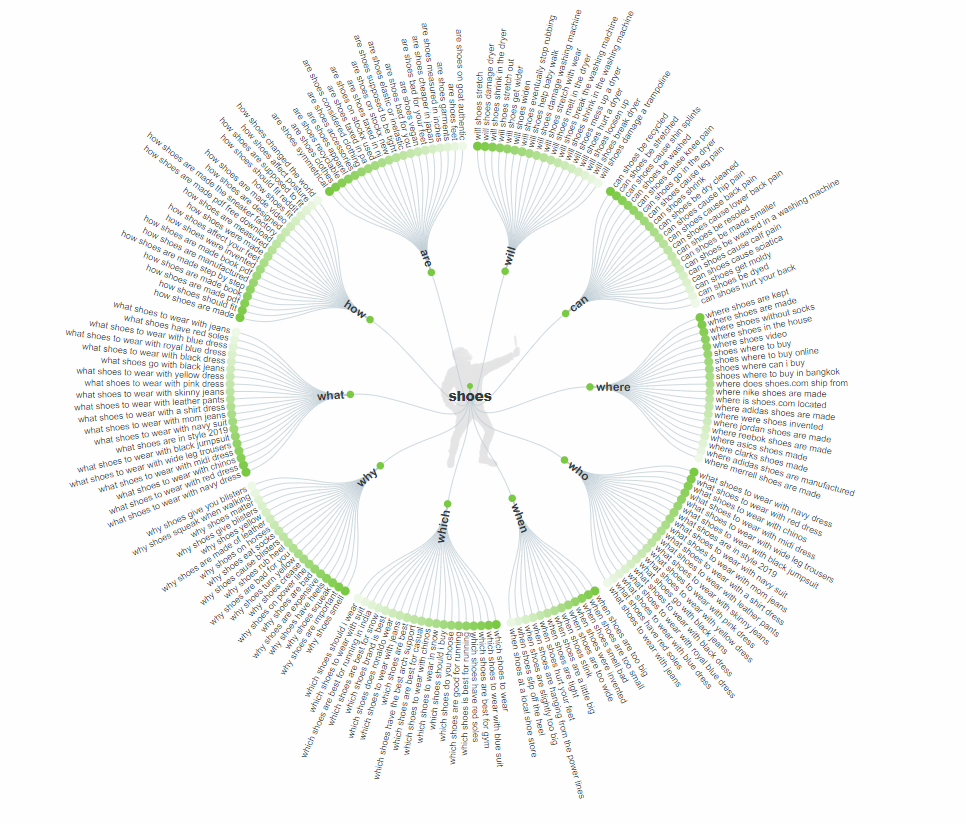
Source: https://answerthepublic.com
To optimise your website for voice search, focus on including short, concise answers (30 words or less) in your content to answer your customers’ questions. The format for your answer can be a paragraph, a list or even a table. If you don’t have a FAQ page, create one. FAQ pages are perfect for voice search.
You can also look into boosting your content marketing activities to improve your domain authority. Websites with lots of high authority domains pointing back to them are more likely to rank on top search results, and therefore be picked up in voice search results.
If you are a local business, make sure that you have created a business profile on Google My Business and that it includes all the important information related to your business. A lot of people use voice search to find local businesses near them, optimising for local SEO is a great opportunity to stand out from the competition and bring in more consumers.
SEO CONSIDERATIONS
In addition to this, you need to make sure your website follows general SEO guidelines.
Your website must be easily crawlable by Google bots so your pages can be indexed in the search result pages. How? If you haven’t done it yet, create a sitemap and submit it to Google Search Console. You can also add Schema Markup into your code, it will help search engines in return for more informative results to the users. Some say there is no correlation between Schema Markup and voice search (yet) but it can’t hurt your website to use it.
Site speed is also an important factor to look into for both your rankings and the user experience. If your site speed is well optimised on both desktop AND mobile, your website will be more likely to appear in the top search results and therefore in voice search results.
Having a mobile-friendly website is also very important for voice search optimisation. Mobile users are the ones using the voice search feature the most. Mobile-friendliness is also a big ranking factor since Google released its Mobile First Indexing back in 2018.
Voice search optimisation is not an exact science, but we can’t say SEO has ever been, either! The most important takeaway is to make sure your website is well optimised. Once this is taken care of, you can integrate our voice search recommendations into your content and settings.
To learn more about how Locaria can help you optimise your website for voice search across global digital markets, contact us for a quote today.