

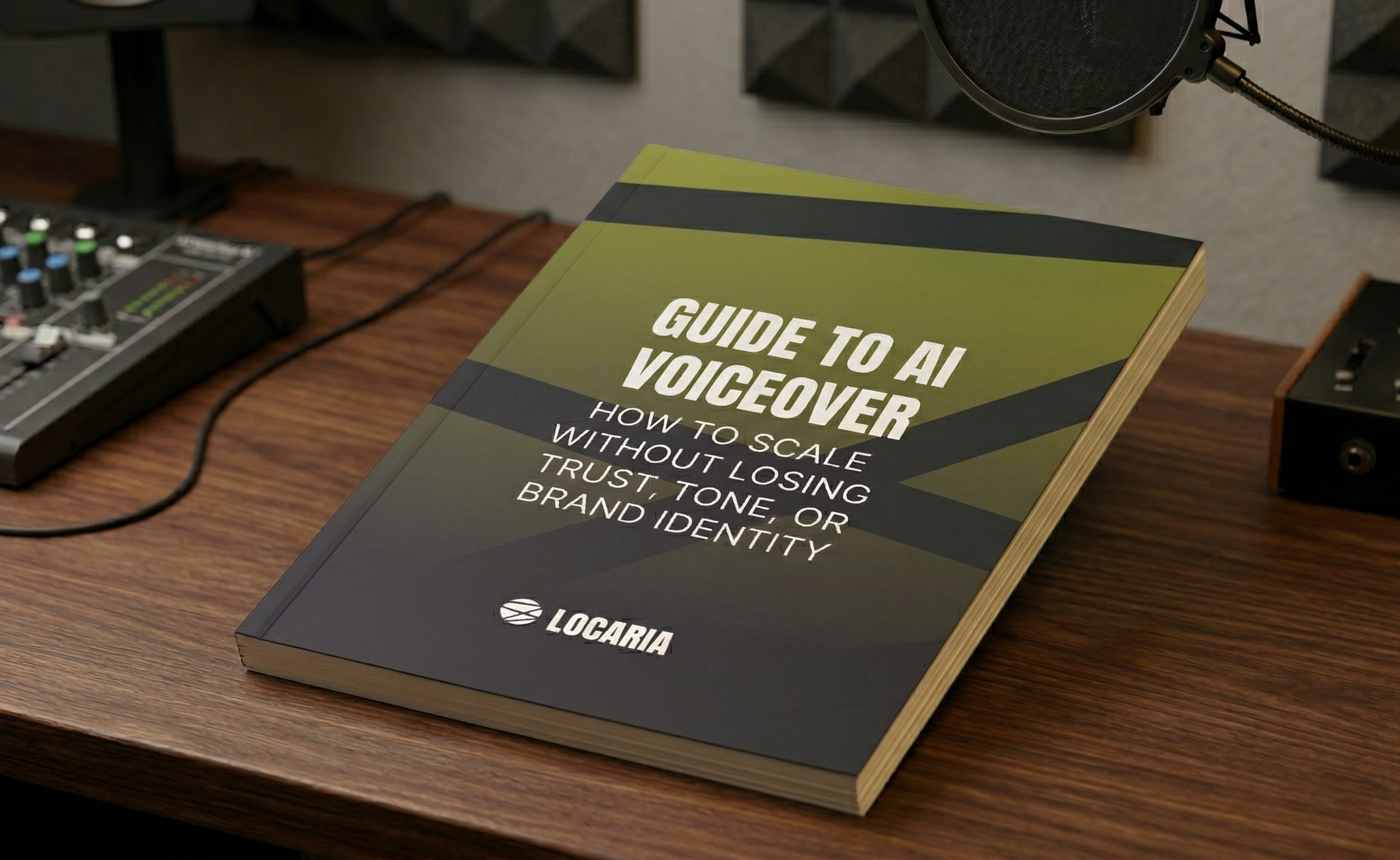
Guide to AI Voiceover: how to scale without losing trust, tone, or brand identity
TL;DR
1) Use AI voiceover for speed, scale and versioning. Use human talent when nuance, trust, and performance hinge on micro-delivery.
2) Avoid “same-voice syndrome” by designing a sonic identity and owning a distinct voice library, not relying on default stock voices.
3) “Directing” AI is a mix of prompt craft, phonetics, and post-editing, plus native-speaker review for every market.
4) You still need an audio engineer, because mixing, continuity, QC, and platform-ready loudness standards do not disappear.
5) The biggest risks are rights, consent, deepfake exposure, brand trust, and inconsistent in-market quality.
Why we wrote this
Locaria supports global clients delivering multilingual voiceover and AI voiceover across markets. We see where synthetic voice accelerates output, and where it quietly introduces brand risk, quality drift, and governance gaps if teams treat it as “just a tool”.
The rise of synthetic storytelling
Global teams are producing more content, in more formats, across more markets. The systems supporting that work are often fragmented, with handovers between agencies, localisation, and production that slow everything down and dilute creative intent.
AI voiceover is attractive because it appears to remove the biggest bottleneck: studio time. In reality, it moves the bottleneck. Once you can generate voice at scale, the work shifts to:
1) Sonic strategy and brand governance
2) Localisation and transcreation decisions
3) Review and QA, especially for pronunciation and cultural tone
4) Post-production, mixing, and platform-ready delivery
That shift is manageable. It is also where most teams get caught out.
When should I use a human voice actor vs. an AI voiceover?
A useful rule is this: choose the method that best protects creative integrity and audience trust in the moment that matters most.
Use AI voiceover when:
You need scale and versioning. High-volume cutdowns, multiple durations, many languages, many placements.
You are localising a consistent brand character. A founder voice, mascot, or recurring narrator where consistency matters across markets.
You need speed to market. Reactive content, rapid testing, and updates that would otherwise stall on scheduling and re-records.
You are filling functional roles. Instructional videos, product walkthroughs, internal comms, explainer content where clarity beats drama.
Use human talent when:
The message relies on empathy and believability. Healthcare, finance, public service, or any work where the audience is listening for sincerity.
Performance is the idea. Comedy timing, emotional storytelling, character work, or high-stakes brand campaigns where nuance drives recall.
You need real human imperfections. Breath, hesitation, and micro-variations can signal honesty. A synthetic voice can sound correct and still feel wrong.
In practice, many global programmes become hybrid. Human talent sets the “hero” voice and emotional reference. AI voiceover supports localisation, versioning, and long-tail adaptation, with stronger controls.
How do we prevent our brand from sounding like every other AI voiceover ad?
The fastest way to sound generic is to treat voice as an asset you borrow, rather than an identity you design.
Three moves help brands keep distinction.
1) Build a sonic identity, not a voice file
If your brand has a written tone of voice, you also need a sonic equivalent: pacing, warmth, energy level, and how that changes by channel. This is not an audio moodboard. It is a set of decisions that can be repeated and measured in-market.
2) Own your voice library
Many teams default to whatever voice is popular in a platform library. That is how markets fill with the same cadence and the same “friendly narrator” texture. Instead, define a small set of brand voices, with clear use cases:
1) Hero narrator
2) Functional explainer
3) Regional variants where cultural norms require it
This also reduces operational drift when multiple teams generate audio in parallel.
3) Protect transcreation, not just translation
Brands lose distinction when localisation becomes literal. Transcreation protects rhythm, idiom, and intent. Without it, even a perfect voice will deliver lines that feel like translated copy, not local communication.
How do you “direct” an AI voice to get the right tone?
Directing AI voiceover is closer to audio engineering than casting. You are not coaching a performer in real time. You are shaping a system through constraints, references, iteration, and post-editing.
What tends to work in practice:
Start with a reference performance
A high-fidelity reference read gives you an emotional blueprint. It anchors pace, emphasis, and intent before you scale into multiple markets and versions.
Direct in layers, not in one prompt
Most teams fail by trying to get a perfect read in one go. Better results come from structured iteration:
1) First pass for clarity and pacing
2) second pass for emphasis and phrasing
3) Third pass for pronunciation, names, and brand terms
Use phonetics and stress controls for meaning, not perfection
Some errors are not “mispronunciation”. They are meaning errors. A single word stress change can flip intent. Native-speaker review is non-negotiable for this reason, especially when you are localising at volume.
Finish like it is real audio, because it is
Even an excellent synthetic voice can feel detached if it sits incorrectly in the mix. Room tone, compression, EQ, and consistent loudness help the voice belong inside the asset, not float on top of it.
Do I still need an audio engineer if I’m using AI?
Yes. In many workflows, you need one more than you expect.
AI voiceover reduces studio recording. It does not remove:
Mixing and mastering so audio matches brand standards across channels
Continuity across versions and campaigns
QC for clicks, glitches, unnatural breaths, or timing drift
Delivery specifications for platforms and broadcasters
Blending with music, SFX, and dialogue so the voice feels intentional
Teams also underestimate the operational load created by high-volume versioning. Without an audio engineer’s discipline, you get inconsistent output across markets, and that inconsistency is what audiences notice first.
What are the risks of using AI voiceovers in advertising?
The risks are manageable, but they are real. They sit in three places: rights, trust, and quality control.
Rights and consent risk
Voice has identity implications. Brands need clear consent, usage scope, and storage controls, especially when cloning is involved. Many organisations already struggle with talent usage rights across borders. AI does not simplify that. It can amplify the consequences of getting it wrong.
Deepfake and misuse exposure
Even when a brand acts responsibly, synthetic voice changes the threat model. Governance needs to cover who can generate audio, where models and samples are stored, and how outputs are approved.
Brand trust and audience perception
A voice can be technically accurate and still create unease if it feels emotionally flat or mismatched to category expectations. This matters most when credibility is fragile.
In-market quality drift
Local teams often receive assets late and are forced to “make it work”. AI voiceover can increase output volume and reduce review time unless the workflow is designed for quality. That is how brands end up with inconsistent tone across locales, and a loss of brand voice that looks like a localisation problem but is really an operating model problem.
Experience injection: a practical multilingual AI voiceover operating model
In global delivery, consistency comes from a repeatable system:
1) Start with a locked master script and a reference recording as the emotional blueprint
2) Transcreate with local stakeholders, then back-translate for sign-off
3) Choose the sonic approach: clone, new character voice, or curated voice library
4) Generate options, then run native-speaker review for inflection, ambiguity, and pronunciation
5) Mix and master so the synthetic voice matches the asset’s original tone and flow
6) Final QC, then deliver with clear naming, version control, and rights documentation
This is how AI voiceover becomes a performance lever rather than a production shortcut that quietly erodes quality.
Download the white paper
FAQ
Is AI voiceover “good enough” for premium campaigns?
Sometimes. If the creative relies on nuance or trust, many brands still anchor the hero asset with human performance, then use AI for versioning and localisation with tighter controls.
Can we use one voice globally?
You can, and it can build consistency. But you still need transcreation and cultural tuning so the same tone lands appropriately in-market.
What is the first governance step we should take?
Define who owns approval, who can generate outputs, how consent and rights are documented, and what “pass” means in each market. Without that, scale becomes noise.
Latest Blog Articles

