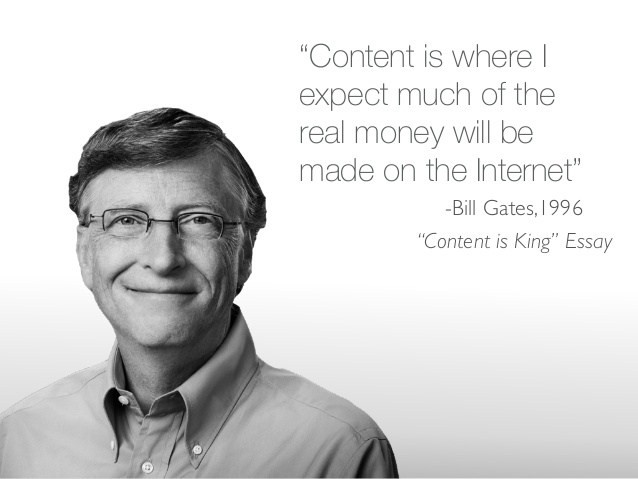
You may have heard of Bill Gates before – “Content is King” was the name of one of Bill Gates’ essays in 1996. It’s a phrase we love to use in SEO. Good content is the base that allows users to find you and your website. Google wants to deliver the best search results in the world. Your website won’t be able to compete with your competition if your content doesn’t help users find what they’re looking for.
Keyword research can be helpful if you want to publish content that people are looking for, but if you don’t want to do that, think about what the audience in your niche is interested in. The more niche your topics are, the easier it can be to get visitors, as competition is generally lower than it is with more general topics and terms.
Another very easy trick is to look at Google’s related searches, which can usually be found at the bottom of your search results to give you more inspiration.
It’s also very important to keep your content fresh and unique. Update your current content, add new content, and don’t copy entire content pieces from other pages unless you want to quote someone. A common weakness of content creators who want to add SEO to their strategy is a lack of understanding of user intent. Always ask yourself if you would like to find your page if you’d be searching for your keywords. Always remember to write for the user and not the search engine. Search engines have their flaws and whilst it’s still possible to rank short-term for trending topics, you want to archive sustainable success. Quality is the way to go.
SEO Content in 2018 or How to Write for the Web—a New Approach for Increased Engagement (Moz) are great resources if you want to know more about writing content for the web.
ALT ATTRIBUTES
If you have content on your page, then it’s likely that you might want to use images. The alt attribute is a very simple HTML tag that can be added to images, either manually or eventually through your CMS (Content Management System). In WordPress for example, you can just head to your media library, select an uploaded image and add your very own alt text. The alt text won’t be visible to the reader unless their device can’t load the image. Alt text gives search engines information about what your image is about and give it context.
If you prefer using an HTML tag, you can easily go to the HTML view of your page and make sure to include the following to your image: <img src=”keyword-reseach.png” alt=”Keyword Research example”>.
Alt texts should be relevant to the topics they represent. Don’t try to fill them up with random keywords just to rank better. This is a crucial step, as you may want to get traffic from Google’s image search, too.
TITLE, DESCRIPTION, URL
Whenever you do a search on Google you will find at least these three parts – a page title, a meta description and a URL.
A CMS will usually give you the opportunity to add these to your pages. WordPress for example, uses the title of the page or post, but you can use plugins such as Yoast to add customised titles and descriptions – the free version is usually more than enough for the average user.
The URL is another important part – it may not be a direct ranking factor, but many users will use it to understand the page they’re on or about to click on. We always recommend a clear structure and short URLs without unnecessary parameters. Google’s John Mueller also said:
“It doesn’t mean it’s a ranking factor, but it means that if we have two URLs, and one is really short and sweet, and the other one has this long parameter attached to it, and we know they show exactly the same content, we’ll try to pick the shorter one.”
John Mueller – Senior Webmaster Trends Analyst, Google
INTERNAL LINKING
If you write an article, think about relevant topics on your site worth linking to. Don’t try to link to every little piece of content you might have and don’t force it – you still want to keep it natural. You want to add more value to your content and help your readers. This isn’t only good for your user, it will also make it easier for a search engine to find your content.
LOADING SPEED
The loading time of your site is a very important factor. The rise in mobile users has made it more important than ever to deliver a fast loading website. There are many technical aspects to improve it (e.g. server location, browser caching) but you can also support it by making sure to use light media assets.
Two common examples:
1. You have an image with a size of 4020×1056 pixels, but the image in your article will be 25% less than the actual size. A website would usually resize the image via HTML to fit your website, the web browser however still needs to load the original image.
Bonus: Lossless image compression has improved a lot in recent years. If you still want or have to use a medium or large image, think about compressing it. There are lots of guides and websites that can help you compress your image with ease, without losing quality.
2. If you have a video on your site, you might want to think about disabling any autoloading/play functions. This should be the case by default but it does still happen, and let’s be honest, who likes to visit a page only to find a video unexpectedly blasting through your speakers?
SEO TAKES TIME
You might be very excited now, maybe you just can’t wait to see millions of people coming to your website. Well, here comes the truth: SEO needs time. However, it’s a sustainable option, and these tips are just simple ways to help you optimise your pages while you’re working on it.
Want to know more? Then you might want to look at Google’s own starter guide for SEO.
Need support and would like to run a full professional strategy? Get in touch with us and we’ll be happy to work with you and your website to drive your organic search traffic.