
For decades, video games have been a global cultural phenomenon. Closely entwined with the rate of technological progress, they’ve come a long way in less than 50 years. From the nostalgic 8-bit video game era, to new releases whose graphics take on an almost cinematic quality, the industry has evolved a great deal in a short space of time.
Nowadays, the video game industry makes up over half of the UK´s entertainment market. According to a report from the Entertainment Retailers Association (ERA), the industry now is worth £3.86bn, more than double its value in 2007.
These numbers prove that the video game industry is more lucrative than the film and music industry combined. The UK isn’t an isolated case, as in many countries the gaming industry exceeds the revenue of the film industry.
The highlight here is that 50% of video game revenue comes from localised versions. Hollywood might have the glamour, but video games have the money.
The main countries that have jumped in on this unstoppable entertainment field are Japan and the US. However, Japan only exports roughly 10%-20% of its products. Titles chosen for export undergo meticulous market research, and developers are usually aware of any pre-existing fanbases in the target countries.
This incredibly fast growth means that the amount of content that requires localisation has increased tremendously, as well as the need to accurately adapt video games to suit new target countries.
What to Consider Before Localising a Video Game?
Adapt the Content to the Culture
This step begins with the studio and developers, who research what will sell well in each country from a marketing perspective. These variables can affect features from character design, to the inclusion or deletion of particular cut scenes to better cater to the target audience.
What approach should you take when you notice that in the original video game one of the characters has a specific regional accent? Should you adapt that dialect with one from the target country, and what parameters should you consider for doing so? These are just examples of the types of questions asked when localising and adapting a video game.
In some projects, the translators have more freedom to propose cultural adaptions, however, these decisions are usually taken by the marketing departments based on heavily studied data.
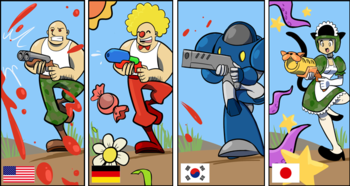
At the same time, most countries have organisations that regulate the content and adaptation of video games, like Entertainment Software Self-Regulation (USK) in Germany, which follows its own regulations out of those established by the European PEGI.
Therefore in this initial step, the video game needs to be analysed to be technically, linguistically, and culturally adapted to be commercialised in other countries.
Based on the previously shared data the US and Japan are the global leaders in video game development, making Japanese and English the most common source languages.
What Is the Nature of Content That Is Going to Be Localised?
Commonly the content will vary from multimedia text, interactive and non-linear content — for example, character dialogue, but without any real context or timeline with regards to when those lines will be displayed in the story.
Additionally, you need to internationalise your code. The architecture and UI of the game must be capable of processing all the target languages. For example, is the game correctly displaying accents in French and Spanish, or are they corrupted?
There will likely also be a number of functionality messages related to the system the customer is using. These compliance messages are extremely important for the game studios and must be tested carefully.
Regardless, the most important thing to consider when localisation planning for video game content is the user. The main aim of localised content should be to reproduce the experience of the original game in target languages and for their respective audiences. For example, you can suggest your translators adapt jokes and wordplay, however, generally, the names of places and characters shouldn’t be changed, as this can affect the seamless internationalisation of the game.
Conduct Quality Assurance
Most of the time, game translators won’t have the full context of what they’re translating, usually due to the confidentiality of the project, as content will likely change as the game is being developed.
Therefore, testing the integration of the translated text into the game is one of the most important parts of the production process.
The most common things that go wrong when a proper QA isn’t conducted, for example, are languages exceeding the available space in-game for the name of an object or prompts that, without seeing them in game, can vary extensively in their meaning. Some of the more famous video game translation blunders like the broken English in the Japanese arcade game Zero Wing have become memes within the gamer community, serving as examples of how not to translate your game, lest it be remembered for the wrong reasons.
Which Assets Need to Be Localised and What Are the Challenges?
When localising the content for a video game franchise, especially if there is a vast legacy of terminology from previous launches, it is essential that the translators work with CAT tools that allow them to automate part of the translation process and access a Translation Memory as well as a terminology database.
There is nothing more upsetting for a long-time fan of a franchise than discovering that their favourite weapon or signature move has been named inconsistently throughout the game. Consistency and accuracy prove that your franchise respects and takes its legacy and fanbase seriously.
These days, some video games are ever-changing, expansive projects with content that evolves through player feedback. However, the average video game usually contains the following assets that will have to be localised when launching internationally:
In Game and On-Screen Text
Such as descriptions and menus. This content can be “clean” or can contain a variety of tags that need to be carefully understood while localising and processing the documents.
Audio and Films
Correctly subtitling and timing all the in-game dialogue.
Manuals and Case
Though manuals are rarely printed anymore, most are made available digitally and must be localised.
Other content
Commonly this can vary from legal to marketing-related documents
One of the main challenges when localising all this content, while taking into account in-game restrictions, is reproducing the experience of the original video game. An extreme re-adaptation made specifically for the target market is not always the answer. Hence, creativity, terminology coherence, and the ability to craft engaging transmedia stories are essential in this vertical.
In the end, the most important factor is that players are able to dive easily into a game, to engage with its world, characters, and story from start to end. With natural, quality-driven, and idiomatic localisation, this can be achieved by gamers across the globe.
Want to find out more about how we can help you localise your game for international markets? Visit our Multimedia Translation page for more information on our services, or contact us today for a quote.