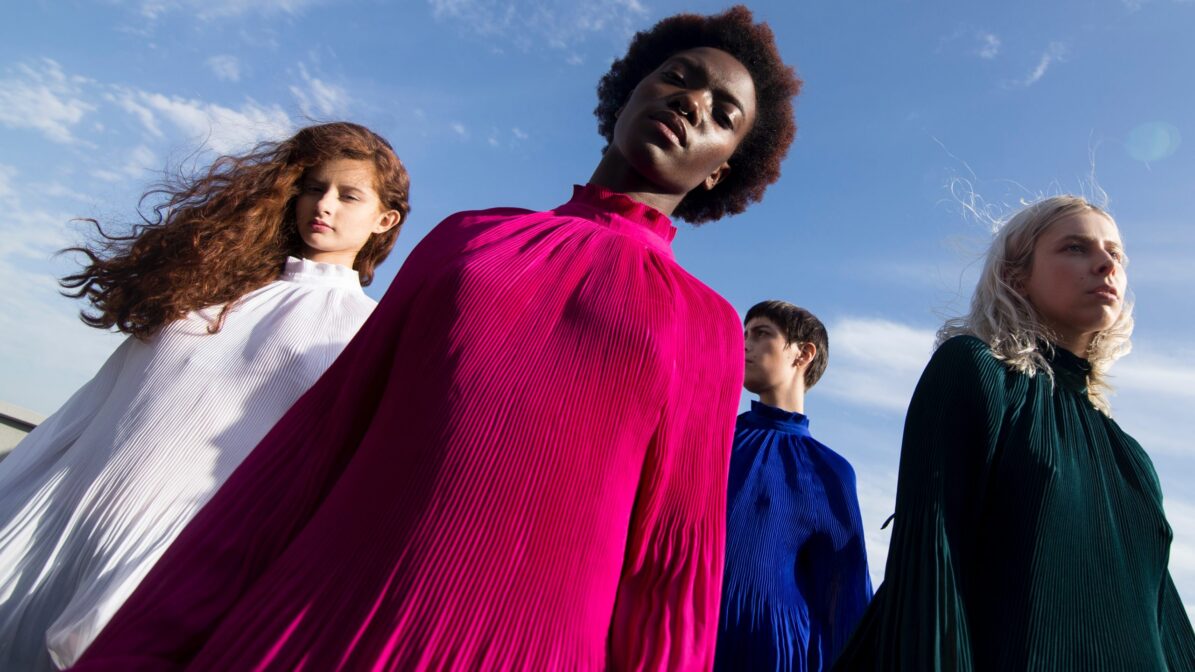
London Fashion Week is here and it is estimated that orders of over £100 million will be placed this season. Taking place twice a year, once in February and September, LFW showcases the creative output of over 250 designers to a global audience of influential media, retailers and consumers.
In addition to London, the ‘big four’ Fashion Week events are also held in New York, Milan and Paris, with smaller events being held in Sao Paulo, Madrid, Los Angeles and Tokyo.
Hugely influential on upcoming styles and trends, the British Fashion Council, the main organiser behind LFW, has stated that this year LFW will be the first of the four global Fashion Week’s to embrace inclusivity, allowing access for the public to “join a celebration of Positive Fashion”.
Well, what is positive fashion? Positive fashion is defined by the British Fashion Council as consisting of three pillars: sustainability; equality & diversity; and craftsmanship & community. This type of positive messaging has become mainstream among fashion brands, which are becoming quick to tout their support for those ideals.
But while these ideals are important, whether or not the fashion world is adequately committing to these values remains to be seen.
Do consumers care about sustainability and diversity?
Yes, to put it simply. According to a McKinsey report, online searches for sustainable fashion ‘tripled between 2016 and 2019‘. Plus, in the UK and USA, more than half of consumers want the fashion industry to become more sustainable. Younger consumers are more likely to be drawn to fashion brands which emphasise sustainability, with the majority of younger shoppers saying they will choose a sustainable retailer over a less sustainable one.
Diversity and inclusion are also prized by consumers, with a report by First Insight Inc highlighting that over half of both and men and women surveyed in the US consider having women and minorities in leadership positions as important. Plus, plus size sizing is also received well by consumers, with 67% of women in the US and 63% of women in the UK ranking it as important.
But are fashion brands embracing positive fashion?
Yes and no. There definitely is an appetite for Positive Fashion. According to McKinsey’s study, which polled 64 global sourcing executives with a combined buying power of $100 billion, more than half of execs want at least half of their products to be made with sustainable materials by 2025.
Plus, there have been recent high profile fashion campaigns which have embraced diversity and inclusivity. Many fashion brands, from adidas to American Eagle Outfitters, launched plus-sized lines last year. In 2018, Marks & Spencer launched its ‘easy dressing‘ range, a clothing range specifically designed for children with disabilities.
Despite some of these attempts at broadening the fashion world, the fashion world is still lagging on sustainability and inclusivity. Only 1% of new products introduced in the first half of 2019 were tagged as sustainable. On the runway, while fashion shows now appear more ethnically diverse, brands are lacking in representation of size, ability, gender or age.
Also notable are not just the areas where fashion houses fail to be proactively diverse and inclusive, but where they display a staggering lack of cultural sensitivity. The fact that fashion is subjective and driven by cultural norms should be a key consideration for brands, but unfortunately, it often isn’t. Some more high profile faux pas include H&M’s “coolest monkey in the jungle” hoodie, Versace’s angering of China by misidentifying Hong Kong and Macau as independent countries, and the culturally insensitive advert, which caused Chinese e-commerce sites to remove Dolce & Gabbana products.
How can brands do better in Fashion Week?
Fashion Week, is a superb marketing opportunity for brands and a good time for brands to reaffirm their values. Whenever Fashion Week comes to New York, London and Milan massive amounts of hype and excitement are generated, attracting the attention of influencers, international press and consumers.
During this time, brands should focus on increasing their organic visibility during Fashion Week to capitalise on the increased search volume. Fashion Week is a very lucrative time for fashion houses. During this period, many luxury to mid-range brands employ a ‘see now, buy now’ model, whereby the runway show becomes ‘shoppable’, for viewers watching online.
Plus, remember those aforementioned cultural faux pas? The Gucci’s, H&M’s and Versace’s would have certainly benefited from having more diverse voices within their marketing teams who would have been able to point out which designs might be construed as racist or problematic.
This is ever more important as consumers in non-Western countries begin to turn to the West for luxury and fashion products — leading to the internationalisation of fashion. Across Asia, consumers are becoming more open to shopping from luxury and fashion brands in the West. Particularly important is cultural nuance when marketing towards those audiences in more conservative countries.
As we have covered before, modest fashion is big business in the Middle East and provides major opportunities for clothing brands and retailers to tap into a new market.
Tailoring your Fashion Week content, to not only include Positive Fashion values but appeal to as wide an audience as possible is important. This will likely have to involve expert localisation of your website and imagery, as well as well-researched and carefully planned strategies for international SEO, social media, email and other channels.
Find out more
If your business is preparing for Fashion Week or looking to embrace a wider audience in another market, contact Locaria to find out how we can boost your chances of success with services ranging from online market research to multimedia translation.