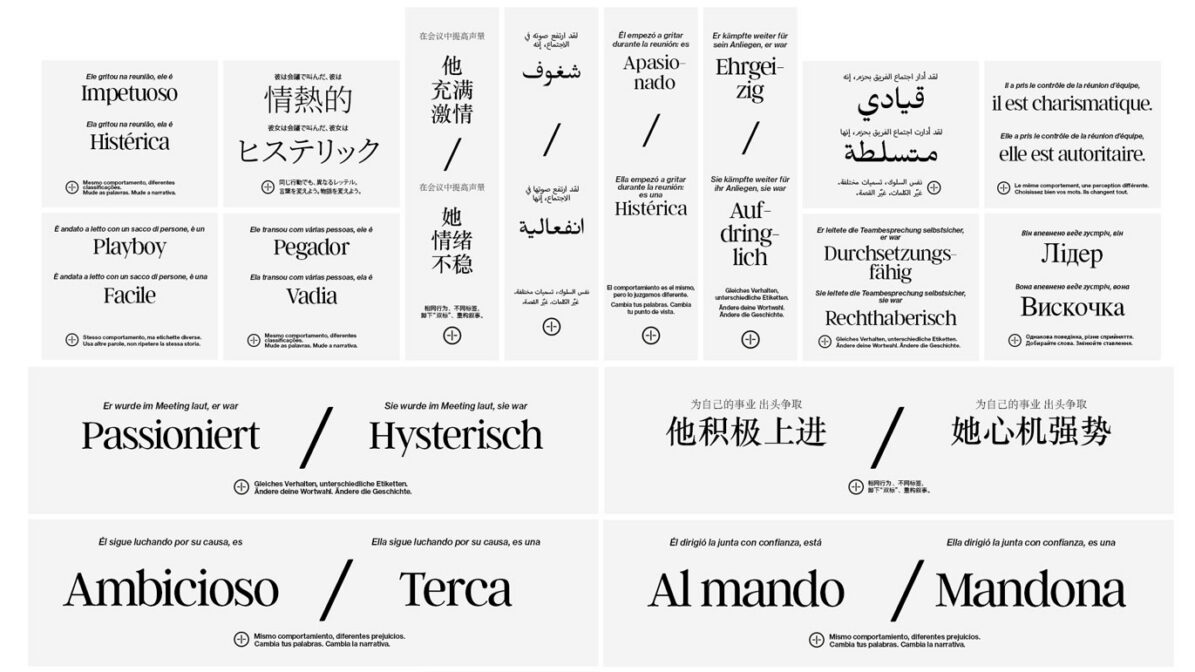
Creative agency CPB London recently developed a campaign for International Women’s Day that looks at how women and men may exhibit the same behaviour, but that behaviour is often labelled differently. The crux of the campaign, titled ‘Double Standards’, is to highlight how sexism is present in everyday language by using couplets such as ‘Passionate / Hysterical’, ‘Assertive / Bossy ‘, ‘Player / Slut’ and ‘Ambitious / Pushy’.
Curious to see whether this was an issue restricted to the English-speaking world, CPB London sought cultural insights and linguistic analysis by teaming up with international content experts Locaria to see whether the same biases could be observed in eleven different languages.
The findings made by Locaria’s localisation teams were conclusive: similar gender biases were omnipresent in the couplets that were researched and the linguistic teams were able to transcreate the copy into their native languages with culturally relevant examples. However, there were some additional nuances and relevant findings that were highlighted throughout the research.
Challenging Gender Biases
The premise of the ‘Double Standards’ campaign is to call out the fact that language is frequently used pejoratively, albeit sometimes unconsciously, to propagate sexist attitudes and negative stereotypes. And by shining some limelight on it via this campaign, we are individually made more accountable and challenged to reflect on the everyday lexical choices that we make.
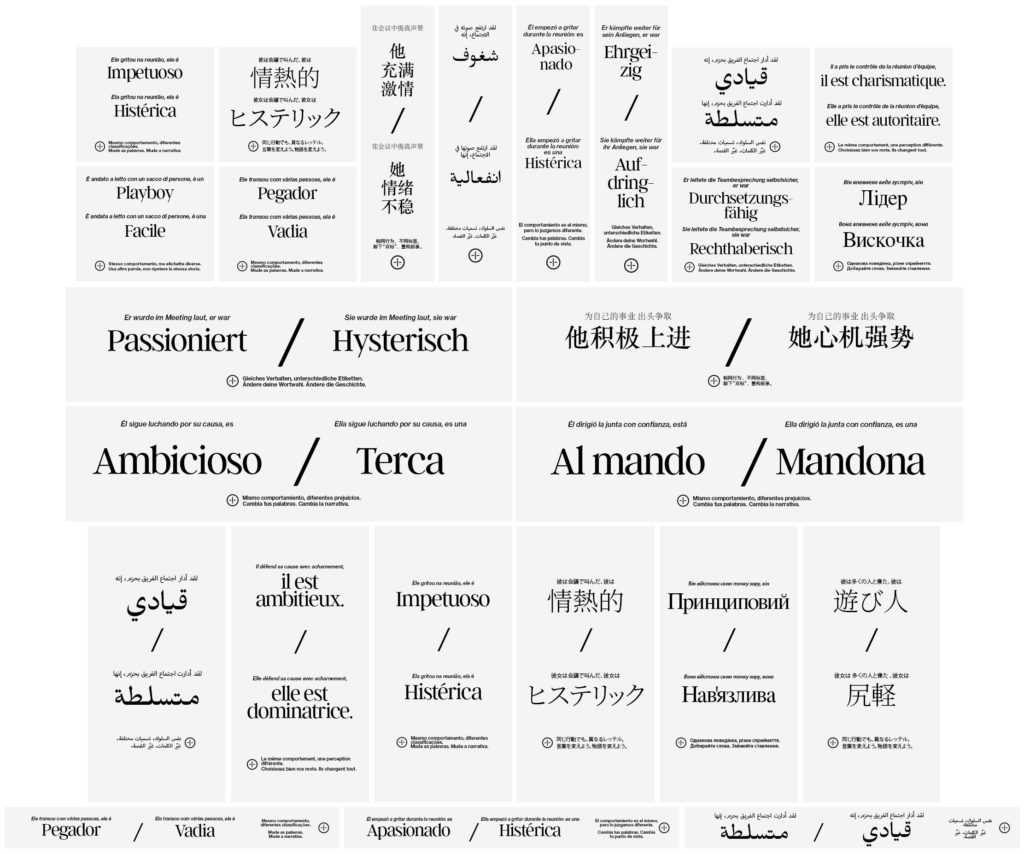
In addition to promoting accountability, the couplets also show the extent to which gender biases are all-too-present in common vocabulary, and not only for English speakers. This issue is magnified when we are able to observe similar disparities across different languages, including those that Locaria used to conduct its linguistic analysis: Arabic (Egypt), Chinese (Mandarin), French (Canada/France), German, Italian, Japanese, Spanish (Latin America/Spain) and Ukrainian.
What’s interesting is the additional feedback that came from Locaria’s linguist team, highlighting further instances of gender-biassed language. For example in Spanish (Spain) there were additional observations about derogatory adjectives used to describe the concepts of ‘the best’ and ‘the worst’. The word ‘cojonudo’ (coming from ‘cojones’, or slang for ‘testicles’) and means that something is ‘great’ or ‘the best’, whereas ‘coñazo’ (from the colloquial ‘coño, or ‘vagina’) takes on the completely different meaning of ‘the worst’.
In Italian, the concept of a man who has slept with many people is that he is a ‘playboy’ whereas if a woman were to demonstrate the same behaviour then she is considered ‘facile’ (or ‘easy’). Similarly, when transcreating the same concept in French, it could be said that a man who is successful ‘made his way up’ and successful women ‘went under the desk’.
From the analysis of these couplets, the linguists were able to identify the same kinds of inequalities deeply rooted in all languages. There was however one exception and one of the couplets was excluded from the Arabic analysis as culturally inappropriate in this language.
The Double Standards campaign is the result of a partnership between CPB London and media agencies Assembly, Goodstuff and Open Media; public relations agency KWT Global, and multilingual content activation agency Locaria.
Pledge for Positivity
Together the six agencies are launching a “Pledge for Positivity”, which seeks to galvanise us all into thinking about how we use language. By signing the pledge, teachers, organisations, companies, or individuals commit to:
• Watch out for the sexism that hides in everyday language, learn about it and spread the word.
• Open things up for discussion in safe spaces, aiming to carry people with you versus finger-pointing.
• Research the sexist words or phrases people around you use most. You have to list them to fix them.
• Develop ways to call out sexist language, but with sensitivity. After all, it’s often used unconsciously.
• Spotlight the insidious nature of ‘harmless’ banter: it’s not a get-out-of-jail-free card.
You can sign the pledge here.