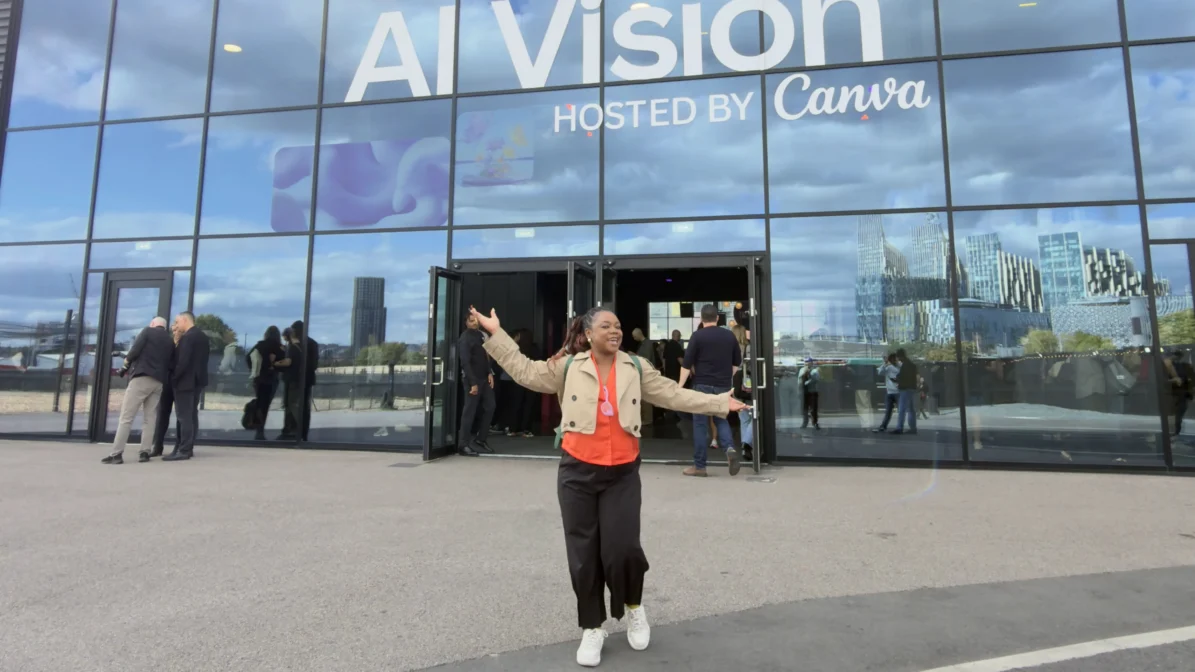
Recap: Key Takeaways from Canva’s AI Vision Event
I attended Canva’s AI Vision event a couple of weeks ago. On the surface, it was a showcase of how fast generative AI has made content production. Underneath, almost every session arrived at the same conclusion from a different angle: speed is no longer the constraint. Quality control is. What stayed with me outside of the fantastic Canva AI demos, was how often the conversation kept circling back to judgement rather than speed, no matter which session was on.
A few highlights worth pulling out:
- In a fireside chat between Canva co-founder and CPO Cameron Adams and OpenAI’s Head of International Marketing, Elke Karskens, the pair discussed adapting a campaign video into Korean in under an hour, alongside a candid conversation about OpenAI’s willingness to slow model releases when safety guardrails haven’t caught up with capability.
- In the panel “On Brand, Today & Tomorrow,” Canva’s B2B CMO Meghan Gendelman, Uncensored CMO founder Jon Evans, and former Mars Petcare CGO Najoh Tita-Reid argued that AI can now nail a brand’s guidelines in seconds — which means the real battleground has shifted to distinctiveness, the human edge no algorithm can fake.
- Black Forest Labs’ Sanjana Tandon (Head of Commercial & Business Development) shared how the company is pushing image generation toward “visual intelligence”, models that reason about context, meaning and intent rather than just rendering pixels, including a case study with publisher Burda that cut magazine production time by roughly 50% while holding brand and character consistency, now extending into multilingual video.
- In “Design the Tool, Then Design With It,” Canva’s Duncan Clark (MD EMEA & CEO, Pro Design) and Hey Studio’s Verònica Fuerte made the case that advanced AI tooling isn’t replacing creative craft, Fuerte’s studio uses it to build custom tools that clear away repetitive work, arguing the smartest use of AI isn’t working faster, it’s becoming a better designer.
- At the roundtable “What’s Worth Protecting,” Superside’s Richard Swain, Revolut’s Gareth Morgan, Made by James founder James Martin, and Creative Boom’s Katy Cowan debated what’s worth defending as AI gets faster. The consensus leaned toward protecting critical thinking and a genuine point of view, while letting “versioning” run wild, a term Swain noted now means something much bigger than reformatting for different channels.
- AWS’s Sasha Rubel (Head of AI/GenAI Policy EMEA) argued in her lightning talk that AI isn’t automating creativity, it’s unlocking it across people who were always imaginative but never had the tools to share it, and asked what happens when we stop designing around constraints that no longer exist.
- The event closed with Exponential View founder Azeem Azhar’s read on where the AI transition is headed next.
Put those together and the theme is clear: AI has closed the production-speed gap. It hasn’t closed the judgement gap. That’s the part we spend most of our time working on at Locaria, and here’s why I think that’s exactly right, and where I believe the real work still comes in.
Why AI Alone Can’t Guarantee Localisation Quality
AI models can exhibit failure modes that aren’t always obvious from the output alone, self-contradiction across a document, undetected factual or linguistic errors, and outputs with no real “rationale” behind a word choice, tone shift, or cultural reference. In English, where training data is abundant, these gaps are easier to catch. In lower-resource languages, they’re not, which is exactly why human involvement matters most in the categories where getting it wrong is most visible: brand voice, sensitive claims, and anything culturally specific.
That’s why, at Locaria, technology and AI is embedded throughout the localisation process, but humans remain accountable for nuance, cultural sensitivity, and accuracy. Professional linguists and post-editors aren’t a finishing step bolted onto AI output, they’re the mechanism that catches what AI alone can’t see in its own work.
Transcreation vs Localisation vs AI Post-Editing: Which Do You Need?
Not every asset carries the same risk, so it doesn’t need the same workflow. We work across three methodologies, matched to what’s actually on the line:
-
- Transcreation: human-only craftsmanship for high-risk, creative, or brand-sensitive work: taglines, voiceover scripts, billboards and OOH advertising. No AI first pass; this is where cultural nuance and emotional resonance are the entire point.
- Human Localisation: applied to paid media copy, press releases, terms and conditions, and editorial content, where accuracy and tone both matter but the format is less creatively driven. It’s also what a website needs whenever the underlying content — messaging, emphasis, the terms local customers actually search on — isn’t right for the market, not just the language.
- AI + Post-Editing: used for website content, CRM systems, emails, blogs, and non-creative publications. AI generates the first pass, matched against term bases and glossaries, before human post-editors refine it for accuracy and natural phrasing.
The skill isn’t picking one methodology and applying it everywhere. It’s knowing which one a given asset actually requires. Find out more about Localisation Planning.
Risk-Based Localisation Workflows: How Tiered Quality Governance Works
We classify content by risk and impact before deciding how it gets localised, light-touch post-editing for low-risk content, heavy human review for high-risk narratives. That classification step is what makes AI-assisted localisation safe to scale rather than a liability waiting to surface in the wrong market.
It’s also increasingly relevant beyond translation. As AI tools move into answer engines and features like Google’s AIMax for paid search copy, upstream governance matters just as much, deciding what an AI system is allowed to generate, and what needs a human input before it ever reaches a customer, prevents downstream errors from becoming public ones. Nowhere is that classification easier to see in practice than on a website.
Why Website Localisation Needs More Than Translation
A product page usually starts in the AI + Post-Editing tier: high volume, lower creative risk, and AI has made it viable to translate far more of a site, into more languages, in a fraction of the previous time and cost. AI + Post-Editing is a strong fit once the underlying content is already right for the market, the job at that point is linguistic: natural phrasing, terminology consistent with the brand’s glossary.
What it can’t do is tell you whether the content itself is right for the market in the first place. Local customers might search on different terms, respond to different messaging entirely, or need a different emphasis than the source page assumes, and a page that reads perfectly well can still underperform if that’s the case. Spotting that gap is localisation’s job, not post-editing’s.
Applied that way, AI + Post-Editing carrying volume and speed where content is market-ready, localisation stepping in to close the gap where it isn’t, a website stops leaking revenue market by market and starts converting instead.
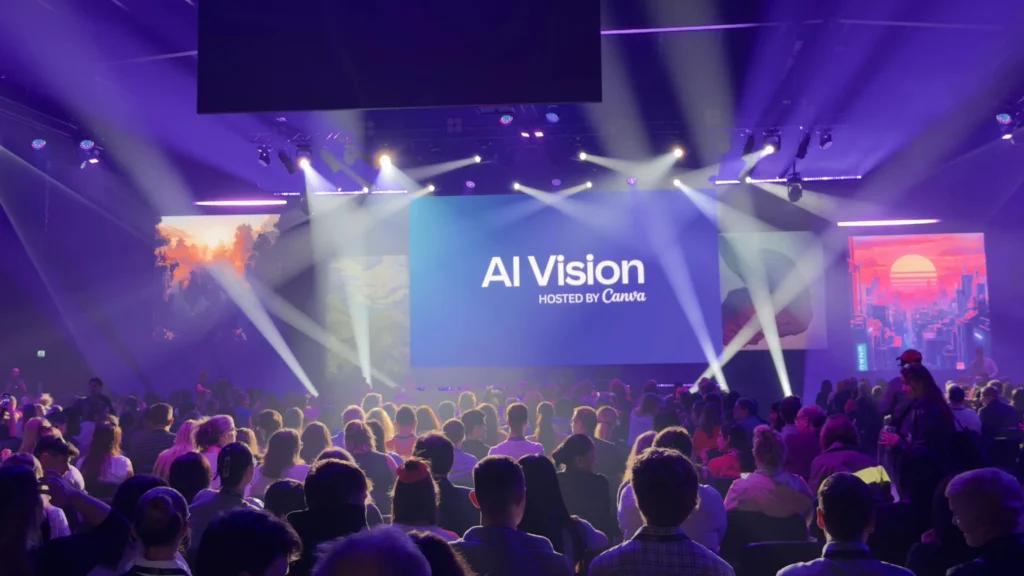
The Bottom Line: Where AI Speed Meets Human Judgement in Localisation
Canva’s AI Vision event confirmed what I already believe, and what we build for every day at Locaria: linguistic adaptation speed is a solved problem, and it’s only getting cheaper. What’s still entirely a human responsibility is classifying risk correctly, choosing the right methodology for each asset, and catching what AI can’t see in its own output. That’s the difference between content that’s mass translated and content that’s actually localised.