
Kate Spade – Fashion and Retail Cross-channel Localisation
How Locaria kept Kate Spade’s luxury tone of voice consistent across channels and markets, increasing brand awareness while reducing turnaround times and localisation costs.
Lower voiceover costs than traditional casting and studio recording
Languages from one French master
Formats across TV and digital
Talent agreement covering every language
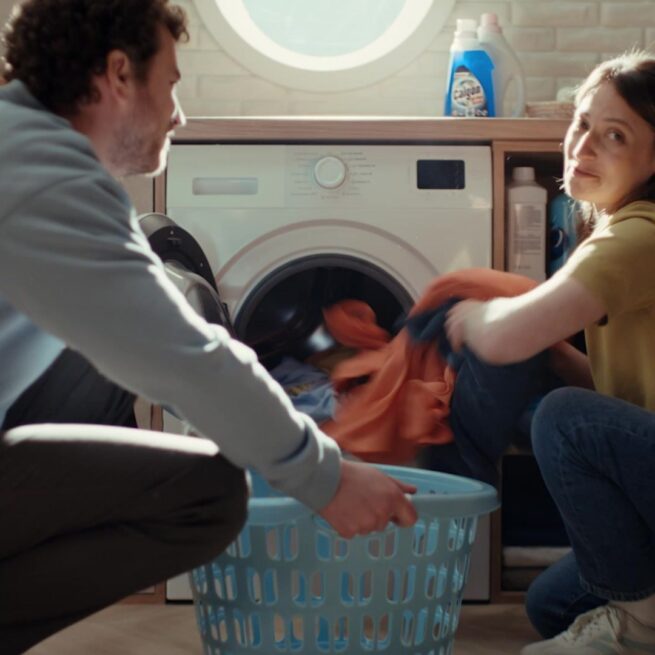
Calgon, the washing machine care brand owned by Vestacy, needed its French master campaign to work naturally in German, Italian, Portuguese, English, Romanian and Polish, across 22 TV and digital formats. The creative relied on an actor speaking directly to camera. International advertising usually avoids on-camera dialogue because it is so hard to adapt convincingly. As Silke Schmidt-Albert, Production Director EU/ANZ at production consultant MCA, puts it: “Poor lip-sync can look unnatural and affect how consumers connect with the character, potentially reducing the emotional impact and effectiveness of the commercial.” On MCA’s advice, Vestacy chose AI voice cloning to “remove a longstanding creative limitation while preserving the authenticity of the original performance across markets”, and briefed Locaria to deliver it from start to finish.
Recasting a voice artist in every market was the traditional route. Vestacy and Locaria saw three reasons to do it differently.
01
“Voice cloning allowed us to preserve the performance we had originally cast and the tone we had spent time directing on set, while simply changing the language.” No new interpretation of the character from one market to the next.
02
“The voice remains covered by the original talent agreement, rather than creating another contract to manage and renew in every market.” Nadine Hagenow, Global Localisation Lead, Vestacy.
03
With traditional voiceover, extending usage rights usually means additional fees. AI voice offers a more flexible, scalable alternative that keeps quality while making localisation more budget-friendly.
Vestacy has no plans to go fully digital. Casting still has to be right for the creative, with a performance that carries emotion and the authenticity that makes the story believable.
“What an AI-cloned voice allows is a way to carry an artist’s performance far beyond its home market, not to replace the artist. The original performer’s contribution remains central: across every language, the voice belongs to the talent on screen, and we secured their approval to create and use the clone.”
Nadine Hagenow, Global Localisation Lead, Vestacy
The technology changes how the voice is produced. It does not change the linguistic and creative direction needed to make it land in each market.

01 / Transcreation for timing
The French script was transcreated into all six languages for natural spoken delivery and rewritten where needed to fit the existing edit, so longer languages never forced the voice to rush.
02 / Script preparation for AI
Scripts were prepared with AI generation in mind. Certain words, abbreviations and unusual pronunciations were respelt so the engine would read them correctly.
03 / Voice cloning, with consent
With the original actor’s approval, our AI engine captured the tone, timbre, rhythm and character of the French performance, then generated each language in that same voice.
04 / Native-speaker refinement
Internal linguistic and audio experts checked pronunciation, pacing and intonation in every language. Where a line didn’t sound natural, we adjusted the copy, pronunciation direction, timing or delivery and generated again until it did.
05 / Lip-sync and full asset localisation
Lip-sync matched each language to the on-screen performance. In parallel, products, supers and legal disclaimers were localised across all 22 formats, from 6-second cutdowns to the TV master.
You might expect pronunciation, accent or tone to be the biggest challenge. In practice it was speed. “If the translation is significantly longer than the original French copy but still needs to fit the same duration, the generated VO may need to speak too quickly, which can make the delivery sound unnatural or robotic,” explains Tatiana Myronenko, Associate Director, Creative Adaptation at Locaria.
That is where transcreation comes in. A direct translation can be linguistically correct and still not sound natural within an existing edit. Rewriting each line for the ear, and for the cut, is what makes an AI voice sound like it was recorded locally.
“It is a repetitive process: we generate, listen, and identify anything that does not sound natural, then adjust the script or generation settings until we achieve the desired result.”

The French campaign now runs in German, Italian, Portuguese, English, Romanian and Polish, in the original actor’s own voice, across 22 TV and digital formats. The video counts seven languages: the French original plus six adaptations.
“For a brand, this means one expiry date to track instead of 20, and less risk of a market going live under a license that nobody has properly checked. For a brand operating across 20+ markets over several years, a significant part of the value lies there.” Nadine Hagenow, Vestacy
For MCA’s Silke Schmidt-Albert, the bigger opportunity is creative. Voice cloning “can fundamentally change how we approach creative development and production from the outset”, opening the door to on-camera dialogue and direct-to-camera storytelling in campaigns that have to run internationally.
Vestacy sees language-level localisation as where the technology is strongest today. Local accents and subtler regional nuances are “not quite there yet”, but Nadine Hagenow expects that to change: “It could eventually reinvent our media model by allowing us to localise creative with much greater granularity.”
For now, the strongest model is hybrid. “AI provides speed, scalability, and adaptation efficiencies, while human linguistic, creative, and audio expertise ensures that what reaches the audience still feels culturally relevant, natural, and creatively right,” says Tatiana Myronenko. Find out more about our multilingual voiceover services.
So let’s chat. It might be the start of something.
Contact us
