You shot one video. Now you need it amplified into hundreds of formats, languages, and platforms, each one built for a different audience. Our video versioning services take that master toolkit and scale it, without you losing weeks to the process.
Scaling One Asset Into Thousands
Versioning is the process of taking a master asset and amplifying it at scale, for new purposes, new audiences, new formats, and new platforms. A single global, omnichannel campaign can require over 100,000 individual assets. Most teams feel this hit hardest in peak season, when the same asset needs a 30-second cut for TV, a 9:16 resize for Reels, and a translated super for every market, all at once. Without a single point of control, work leaks across agencies, local teams start deviating from the master asset, and nobody has full visibility of what’s been approved.
Locaria manages this scale by splitting video versioning into two deliberate workflows: automation for the assets that can run on templates, and skilled human editors for the assets that need judgement. Every version stays tied back to the original master, so nothing drifts and nothing gets lost.
Creative Automation: The Templated Approach
For repeatable, modular assets, we use automation and templates to cut costs and turnaround time. Smart cropping uses AI to detect and reframe the focal point of a video to fit new aspect ratios, converting a 16:9 TV ad into a 9:16 mobile ad, for example. Dynamic text scaling automatically adjusts typography, font sizes, and line breaks as translated text runs longer or shorter. Linguistic templates are built to handle the constraints that matter, character limits, number rules, and punctuation, by language. And Generative AI is used day-to-day in production and QA, which, paired with human review, speeds up delivery and lowers cost.
Human Versioning: Where Judgement Still Wins
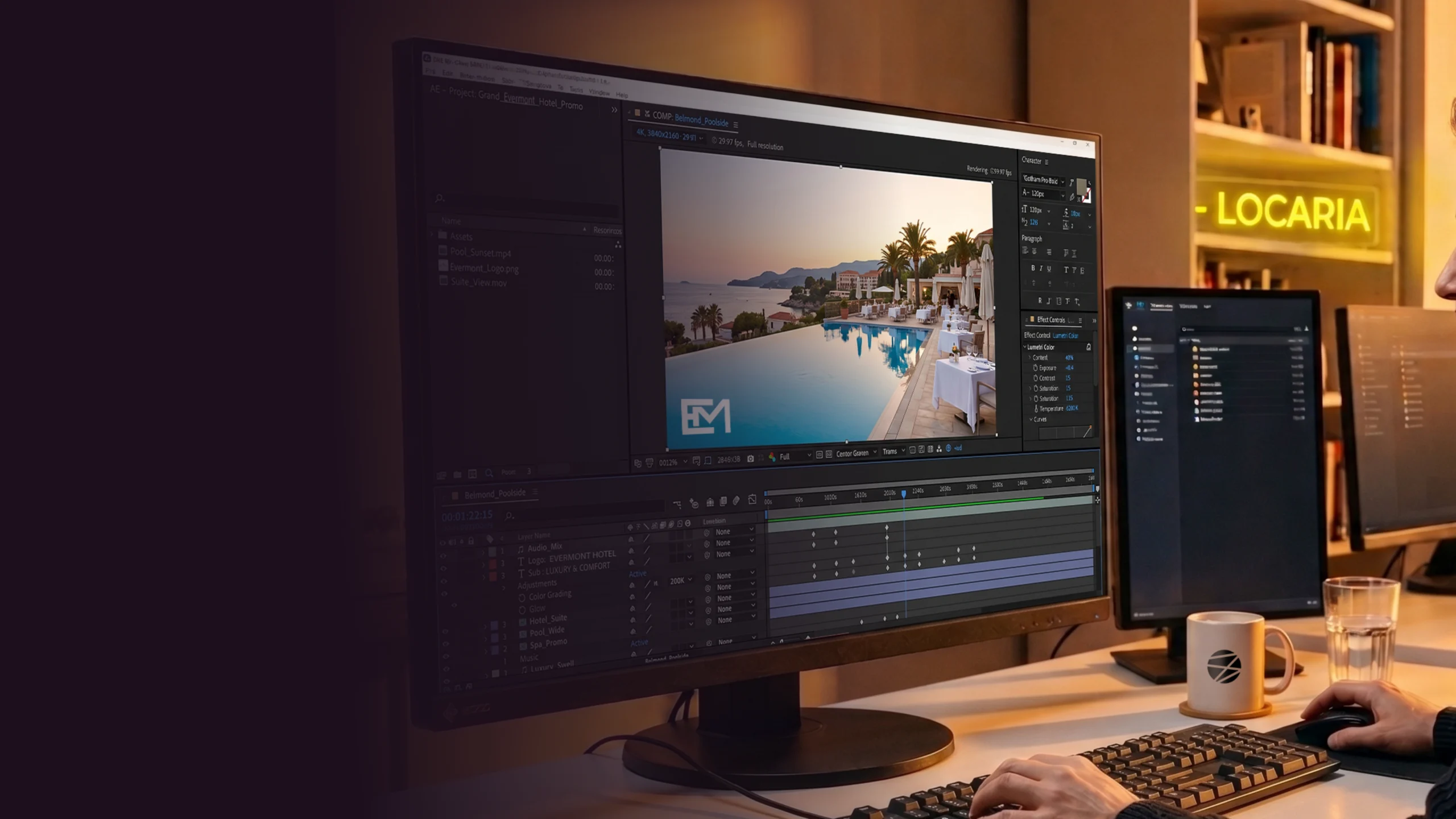
For assets that need judgement, craft, or market-specific changes, we rely on human video editors. Generative AI still works better as a creative enhancement tool, retouching or extending a static background, than as a full adaptation tool. Three challenges keep human editors essential: most creative adaptation is delivered in Adobe After Effects or Photoshop, and many automation platforms don’t integrate smoothly with either. AI tools often crop rather than intelligently resize, cutting out parts of the design that should have stayed. And fonts get misplaced, changes apply unevenly across versions, and the tools struggle with the individual, round-by-round adjustments clients ask for during approval.
What’s Included in Every Version
Every project draws on the same core deliverables. Cut-downs take your long-form master and edit it into 30-second, 15-second, and 6-second spots. Resizes cover every aspect ratio your platforms need, from 1:1 for feed to 9:16 for Reels and TikTok to 16:9 for YouTube. Motion adaptation swaps in translated supers, legal disclaimers, local logos, and end frames for each market. And soundlay and mastering delivers a final audio mix so your new local voiceover sits perfectly against the picture.
Managing the Complexity With Adaptria
Multiply languages by review rounds by delivery destinations, and versioning gets complicated fast. Adaptria, our proprietary platform, keeps every single asset variant tied to its main workflow, with status, ownership, and QC history visible from request to final delivery. It also embeds brand guidelines and governance technology directly into the process, catching errors early and cutting down on late-stage rework.